What Happens When You Find a Bitcoin Block Solo Mining?
A solo miner just hit block #891,234. Here's exactly what happens from the moment a valid hash is found: payout flow, confirmation, and what 3.125 BTC looks like in your wallet.
The moment your miner finds a block
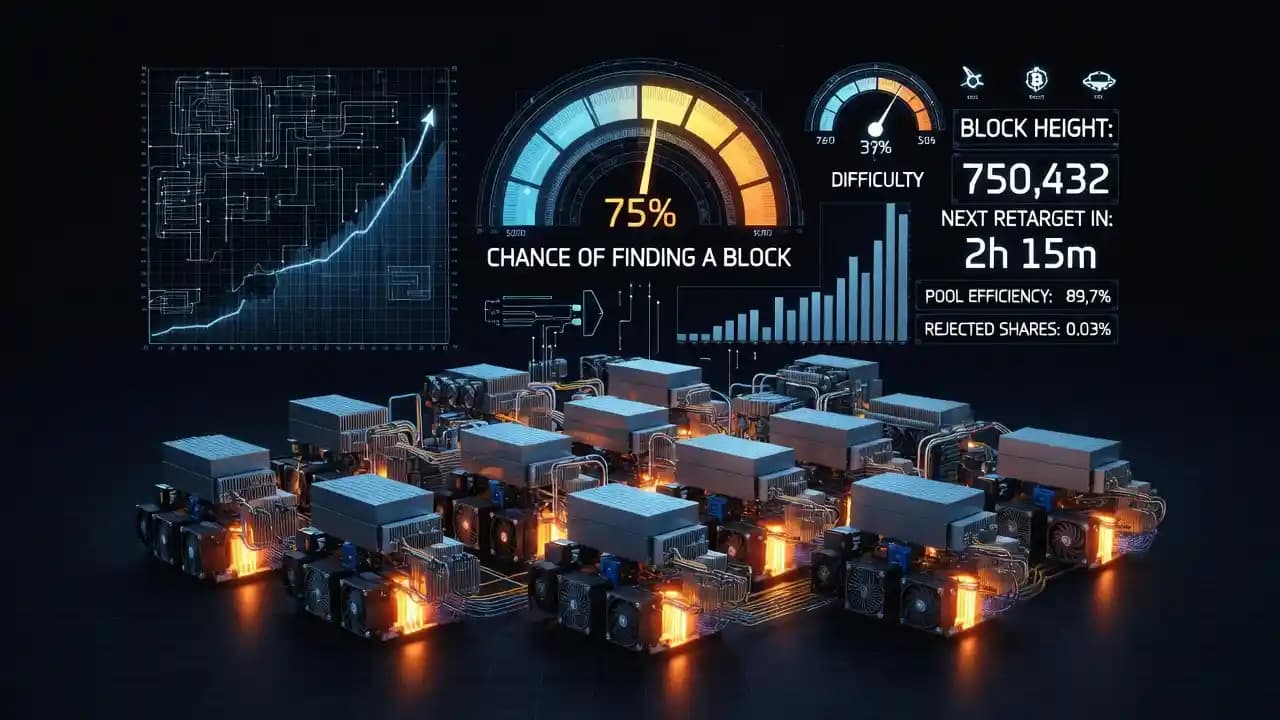
Every hash your ASIC computes is a lottery ticket. When one of those hashes falls below the current Bitcoin difficulty target, your miner has found a valid block. On MySoloPool, the pool's Bitcoin node immediately broadcasts your block to the network — there is no queue and no delay.
Within seconds, other nodes verify your block. Once it receives its first confirmation, the 3.125 BTC coinbase reward (plus transaction fees from that block) is locked to the payout address you configured as your worker name.
Payout timeline
| Stage | Time | What happens |
|---|---|---|
| Block found | 0 sec | Node broadcasts block; appears on MySoloPool blocks page |
| 1 confirmation | ~10 min | Block accepted by network |
| Coinbase maturity | ~100 blocks (~17 hours) | BTC becomes spendable in your wallet |
Why solo instead of a pool?
In a traditional mining pool, the 3.125 BTC block reward is split among thousands of workers proportional to their hashrate. A single S21 XP earning 270 TH/s in a large pool would receive a tiny fractional daily payout. Solo mining flips the math: you earn nothing on most days, but when you hit a block, you keep the entire reward.
Check your odds on the MySoloPool dashboard — it shows estimated time to find a block based on your live hashrate. The lower the network difficulty relative to your hashrate, the shorter the wait.
Pro Tip: Use the Hashrate Farm profitability calculator to model solo mining at different BTC price scenarios ($100K, $150K, $200K).
Real block finds on MySoloPool
Every block found on MySoloPool is publicly visible on the blocks page — block height, reward amount, and the miner's shortened address. Browse past block finds to see what solo mining success looks like in practice.
Ready to try the Bitcoin lottery? Get started with the setup guide. Need hardware? Hashrate Farm sells ASIC miners with optional hosting contracts so you can deploy immediately.
Tags
Author & editorial standards
Written by MySoloPool Editorial Team. Reviewed under our editorial policy for solo-mining accuracy, pool operations, and transparent fee disclosure.
Continue This Topic
Solo Mining Playbooks
Execution playbooks for setup, failover, and scaling decisions.
Trust Center
Operational transparency and support standards for solo miners.
Dashboard Search
Inspect workers and track stability signals using live dashboard views.
Getting Started Guide
Walk through clean setup flow and first-run validation checks.
Looking for mining hardware, hosting, or cloud mining? Hashrate Farm Blog has hardware reviews, profitability guides, and industry news.
Related Posts
MySoloPool's First LTC+DOGE Solo Block Is On-Chain
On 13 August 2026 our Scrypt solo pool solved Litecoin 3,159,431 and Dogecoin 6,330,706 in the same second. Here's the coinbase split, the explorer links, and where to point an L7 or L9.
MySoloPool Multi-Coin Solo Pools: BTC, BCH, LTC+DOGE, and ZEC Under One Brand
MySoloPool runs solo lottery stratum for Bitcoin, Bitcoin Cash, merged Litecoin+Dogecoin, and Zcash. One philosophy: wallet-as-username, fee on block find, live dashboards—pick your algorithm.
Zcash Solo Mining on MySoloPool: Equihash Setup for Z15 and GPU Rigs
Point Equihash miners at zec.mysolopool.com with your ZEC address as worker. Vardiff on :3330, NiceHash rentals on :3331, 3% fee on block find, live stats at zcash.mysolopool.com.