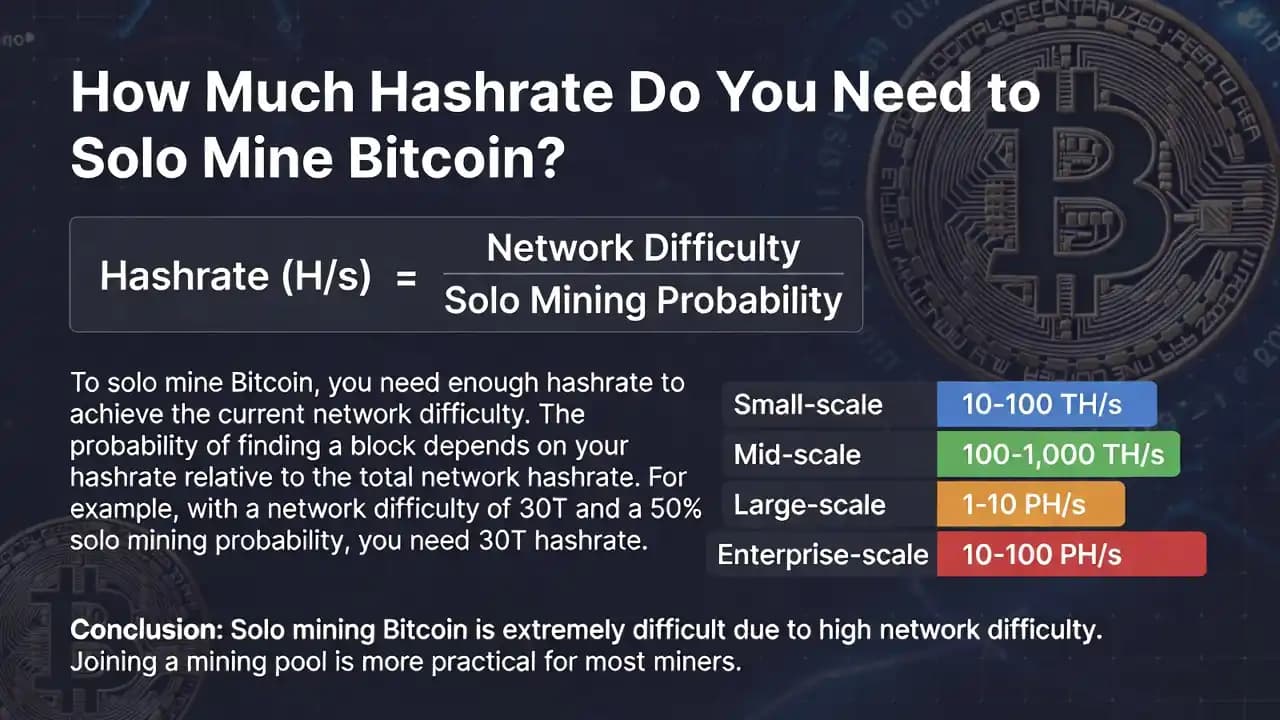
How Much Hashrate Do You Need to Solo Mine Bitcoin? Formula and Realistic Ranges
You can solo mine with any hashrate, but expected time to a block scales with network difficulty. Here is the exact relationship, example numbers for 2026-era network size, and when solo starts to feel practical.
Direct answer: You do not need a minimum hashrate to solo mine Bitcoin—but your expected time between blocks is roughly network difficulty × 2³² ÷ your hashrate (in seconds), which simplifies in practice to: more hashrate = proportionally shorter average wait. At roughly 700–900 EH/s network hashrate (typical 2025–2026 range), a single modern ASIC (200–270 TH/s) might see multi-year average times between blocks; multi-PH/s farms see weeks to months on average. Variance is huge either way.
Simple mental model
Think of each 10-minute Bitcoin block as a lottery ticket for every terahash you run. Your share of tickets equals your fraction of the global network. Solo pools like MySoloPool do not change the math—they give you a fair ticket with professional infrastructure.
Reference table (illustrative; network moves daily)
| Your approximate hashrate | Rough setup | Order of magnitude: average time to a block* |
|---|---|---|
| ~6 TH/s | Compact home miner | Many decades (lottery) |
| ~200–270 TH/s | One Antminer S21-class machine | Often years on average |
| ~1 PH/s | Small farm | Months on average (still high variance) |
| ~10+ PH/s | Larger operation | Weeks–months on average |
*Averages are not guarantees. You can hit earlier or much later than the mean.
What to do with this information
- Estimate your hashrate in TH/s or PH/s.
- Check current network hashrate from any major explorer.
- Use Hashrate Farm’s profitability calculator for USD/BTC context.
- Use MySoloPool’s dashboard search to see live stats for your workers once connected.
Warning: Solo mining can mean long stretches with zero block income. Only allocate hashrate you can afford to run through variance.
Tags
Author & editorial standards
Written by MySoloPool Editorial Team. Reviewed under our editorial policy for solo-mining accuracy, pool operations, and transparent fee disclosure.
Continue This Topic
Solo Mining Playbooks
Execution playbooks for setup, failover, and scaling decisions.
Trust Center
Operational transparency and support standards for solo miners.
Dashboard Search
Inspect workers and track stability signals using live dashboard views.
Getting Started Guide
Walk through clean setup flow and first-run validation checks.
Looking for mining hardware, hosting, or cloud mining? Hashrate Farm Blog has hardware reviews, profitability guides, and industry news.
Related Posts
MySoloPool's First LTC+DOGE Solo Block Is On-Chain
On 13 August 2026 our Scrypt solo pool solved Litecoin 3,159,431 and Dogecoin 6,330,706 in the same second. Here's the coinbase split, the explorer links, and where to point an L7 or L9.
MySoloPool Multi-Coin Solo Pools: BTC, BCH, LTC+DOGE, and ZEC Under One Brand
MySoloPool runs solo lottery stratum for Bitcoin, Bitcoin Cash, merged Litecoin+Dogecoin, and Zcash. One philosophy: wallet-as-username, fee on block find, live dashboards—pick your algorithm.
Zcash Solo Mining on MySoloPool: Equihash Setup for Z15 and GPU Rigs
Point Equihash miners at zec.mysolopool.com with your ZEC address as worker. Vardiff on :3330, NiceHash rentals on :3331, 3% fee on block find, live stats at zcash.mysolopool.com.