Bitcoin Mining Profitability Calculator Explained (and How Solo Fits In)
What every field on a mining calculator means—electricity, hash price, difficulty—and how to interpret the result if you are comparing pool payouts with a solo moonshot.
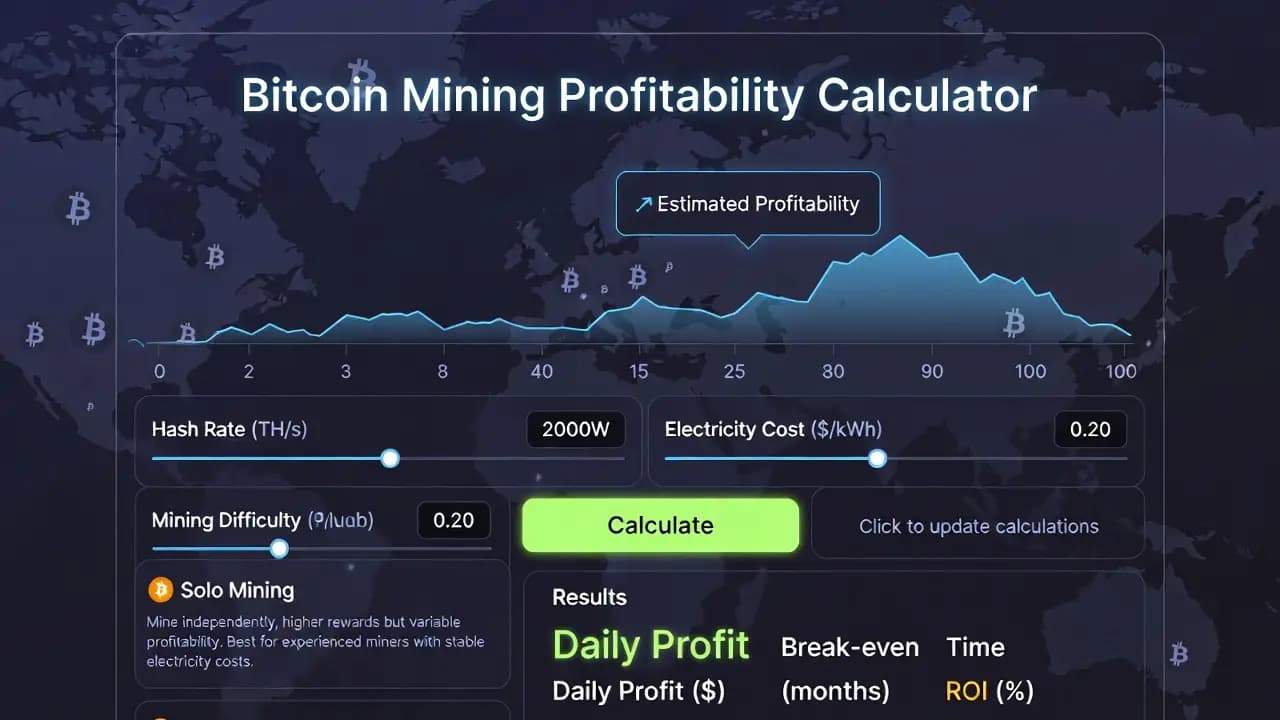
Direct answer: A Bitcoin mining profitability calculator estimates expected revenue from your hashrate at the current difficulty and BTC price, then subtracts electricity and fees to show estimated profit. It answers “what would I earn per day on average if rewards were smooth?”—which matches pool mining closely. For solo mining, the same calculator still describes long-run expected value, but your actual cash flow is lumpy: mostly zero, then a large block payment if you hit.
Core inputs explained
- Hashrate: Your TH/s or EH/s; higher means more lottery tickets per block.
- Power and electricity cost: Watts × $/kWh × time; often the dominant operational cost at home.
- Pool fee: Traditional pools charge 1–3%+. Solo pools may charge a flat percentage—check your operator’s docs.
- BTC price: Converts coin revenue to fiat for budgeting.
- Difficulty / block subsidy: Network parameters; after the 2024 halving, subsidy is 3.125 BTC per block plus fees.
Try it on Hashrate Farm
The Hashrate Farm profitability calculator is built for ASIC shoppers: pick a machine, adjust power and tariff, and read estimated daily BTC and USD. Use it to sanity-check whether you can carry electricity during a long solo dry spell.
Solo vs pool: same EV, different cash flow
Over a very long horizon, expected BTC per TH/s tends to converge whether you pool or solo—the network pays miners collectively. Pools smooth payouts; solo preserves the full block when you win. If you want to experiment with solo without a warehouse, consider renting hashrate and pointing it at MySoloPool’s Stratum endpoints.
FAQ
Why does my solo result not match daily calculator earnings? Calculators show averages; solo reality is streaky.
Do fees change the comparison? Yes—always subtract pool or solo pool fees from modeled revenue.
Tags
Author & editorial standards
Written by MySoloPool Editorial Team. Reviewed under our editorial policy for solo-mining accuracy, pool operations, and transparent fee disclosure.
Continue This Topic
Solo Mining Playbooks
Execution playbooks for setup, failover, and scaling decisions.
Trust Center
Operational transparency and support standards for solo miners.
Dashboard Search
Inspect workers and track stability signals using live dashboard views.
Getting Started Guide
Walk through clean setup flow and first-run validation checks.
Looking for mining hardware, hosting, or cloud mining? Hashrate Farm Blog has hardware reviews, profitability guides, and industry news.
Related Posts
MySoloPool's First LTC+DOGE Solo Block Is On-Chain
On 13 August 2026 our Scrypt solo pool solved Litecoin 3,159,431 and Dogecoin 6,330,706 in the same second. Here's the coinbase split, the explorer links, and where to point an L7 or L9.
MySoloPool Multi-Coin Solo Pools: BTC, BCH, LTC+DOGE, and ZEC Under One Brand
MySoloPool runs solo lottery stratum for Bitcoin, Bitcoin Cash, merged Litecoin+Dogecoin, and Zcash. One philosophy: wallet-as-username, fee on block find, live dashboards—pick your algorithm.
Zcash Solo Mining on MySoloPool: Equihash Setup for Z15 and GPU Rigs
Point Equihash miners at zec.mysolopool.com with your ZEC address as worker. Vardiff on :3330, NiceHash rentals on :3331, 3% fee on block find, live stats at zcash.mysolopool.com.