Best ASIC Miner for Home Mining in 2026: Picks by Budget, Power, and Noise
Home miners need efficiency, manageable wattage, and realistic expectations. Here are practical 2026 ASIC categories—from plug-in solo lottery machines to flagship S21-class rigs—and how they pair with solo pool setups.
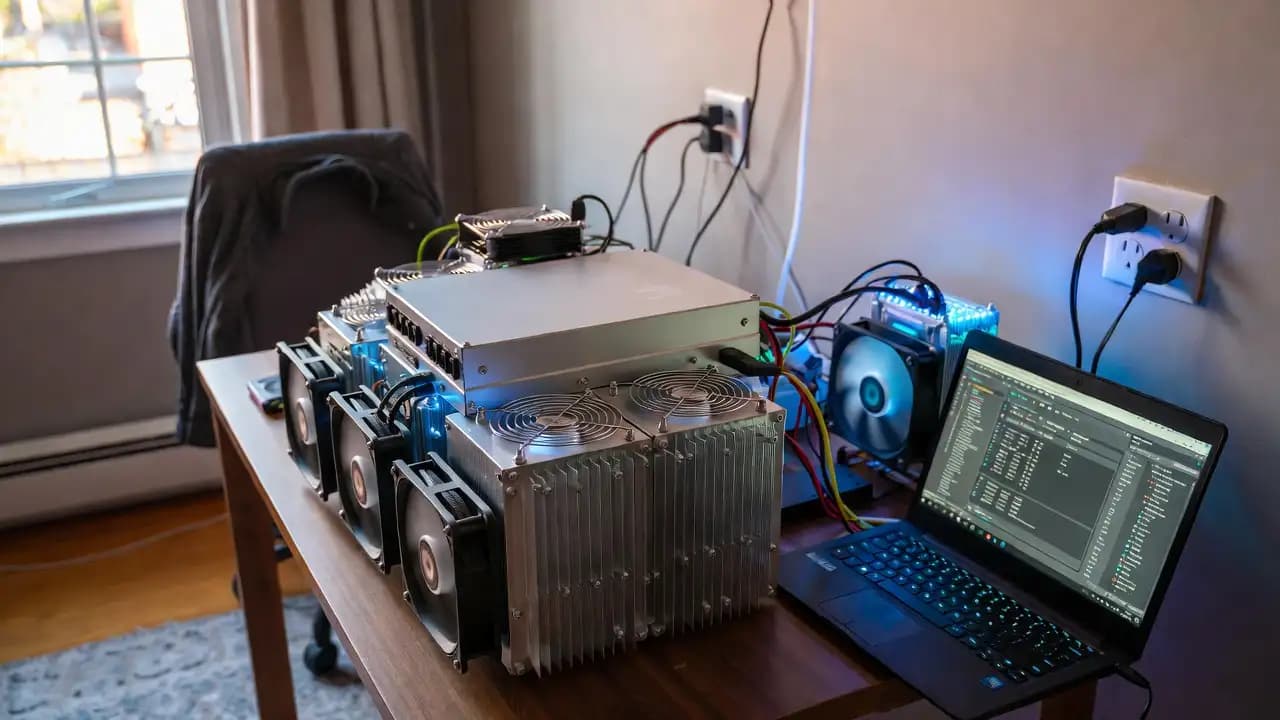
Direct answer: The best ASIC for your home in 2026 is the most efficient machine you can power and cool legally within your panel capacity, noise limits, and budget. Flagship air-cooled units like the Antminer S21 / S21 Pro class dominate on J/TH if you have 240 V and ventilation. Low-power Bitaxe or similar small miners are best if you want a quiet solo lottery ticket without rewiring. Always confirm stock, warranty, and hosting options with your retailer—e.g. Hashrate Farm buy-miners.
Pick by constraint
| Your constraint | Sensible direction | Solo note |
|---|---|---|
| Limited power (120 V, low amp) | Compact or efficiency-focused small miners | Great for learning Stratum + MySoloPool; expect very long block odds |
| 240 V garage / shed | Modern S21-class or equivalent efficiency | Meaningfully better expected time per TH/s than old-gen |
| Noise-sensitive | Lower-watt gear, sound enclosure, or hosted mining | Consider hosting for serious TH/s |
| Capital for scale | Multiple matching units + PDUs | Solo pools shine when variance is tolerable |
Why efficiency matters more after the halving
With 3.125 BTC subsidy per block, margin per TH/s is thinner than in prior eras. Joules per terahash (J/TH) is the scoreboard—lower is better at a given electricity price. Use the profitability calculator before you buy.
Connecting any ASIC to a solo pool
Most SHA-256 ASICs only need the pool URL, worker name (often your BTC address), and password. For Bitcoin solo on MySoloPool, follow the official getting started page for ports and VarDiff tips.
Related Resource
Solo Pool Setup Guide: Stratum URL, worker format, and vardiff settings for ASIC miners.
Tags
Author & editorial standards
Written by MySoloPool Editorial Team. Reviewed under our editorial policy for solo-mining accuracy, pool operations, and transparent fee disclosure.
Continue This Topic
Solo Mining Playbooks
Execution playbooks for setup, failover, and scaling decisions.
Trust Center
Operational transparency and support standards for solo miners.
Dashboard Search
Inspect workers and track stability signals using live dashboard views.
Getting Started Guide
Walk through clean setup flow and first-run validation checks.
Looking for mining hardware, hosting, or cloud mining? Hashrate Farm Blog has hardware reviews, profitability guides, and industry news.
Related Posts
MySoloPool's First LTC+DOGE Solo Block Is On-Chain
On 13 August 2026 our Scrypt solo pool solved Litecoin 3,159,431 and Dogecoin 6,330,706 in the same second. Here's the coinbase split, the explorer links, and where to point an L7 or L9.
MySoloPool Multi-Coin Solo Pools: BTC, BCH, LTC+DOGE, and ZEC Under One Brand
MySoloPool runs solo lottery stratum for Bitcoin, Bitcoin Cash, merged Litecoin+Dogecoin, and Zcash. One philosophy: wallet-as-username, fee on block find, live dashboards—pick your algorithm.
Zcash Solo Mining on MySoloPool: Equihash Setup for Z15 and GPU Rigs
Point Equihash miners at zec.mysolopool.com with your ZEC address as worker. Vardiff on :3330, NiceHash rentals on :3331, 3% fee on block find, live stats at zcash.mysolopool.com.